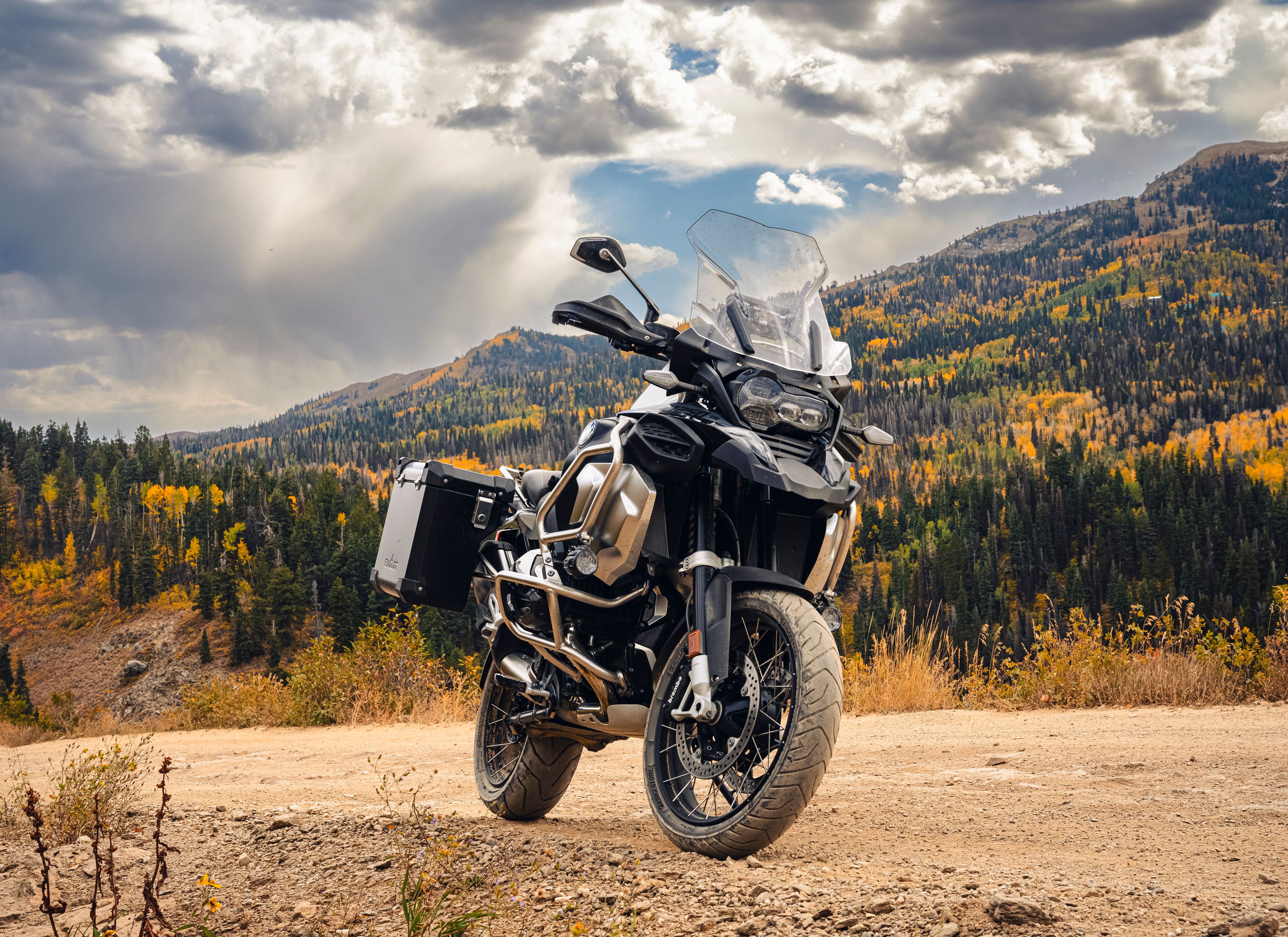
If you have done a motorcycle road trip before, you already know the basics. Plan your route, book a place to sleep, pack what fits, and go.
An ADV trip follows the same general logic, but the details differ enough that road trip assumptions can work against you.
Here is what changes when the route leaves the pavement.
The Route Is a Starting Point, Not a Plan
On a standard road trip, your route is pretty much your plan. You know the roads, you know the distances, you know roughly what to expect.
ADV route planning works differently. The line on the map might be a paved highway, a well-maintained fire road, a rocky two-track, or something in between. Sometimes it is all four on the same day. The route tells you where you are going. It does not tell you what that actually looks like.
Before you commit to any stretch of road, research the surface. Forums, apps like Gaia GPS or iOverlander, and ADV-specific communities are your best resources. Riders who have been there will tell you what pavement ends, where gravel gets technical, and whether a road that looks passable on a map is actually rideable on your bike.
Build flexibility into your itinerary. On a road trip, missing your exit costs you ten minutes. On an ADV route, unexpected terrain can cost you hours. Leave room in your schedule for things to take longer than planned, because they often will.
Fuel Planning Is a Different Calculation
On paved roads, gas stations are close enough together that fuel is rarely something you think about. Off the beaten path, that changes fast.
Some ADV routes run through stretches where services are 100 miles apart or more. On rough terrain, your fuel economy drops. A bike that gets 50 miles per gallon on the highway might get considerably less on a long day of gravel and dirt.
Before any ADV trip, know your bike’s real-world range in mixed conditions. Plan your fuel stops around conservative estimates, not optimistic ones. If you are heading into genuinely remote territory, consider carrying a small auxiliary fuel container. It is not something most road trippers think about. For ADV riders heading off-grid, it can matter.
The rule most experienced ADV riders live by: top off whenever you can, even if you are not low.
What You Pack Is Different
A standard moto road trip packing list centers on clothing, toiletries, and whatever you need for the nights. An ADV packing list has all of that plus a layer of mechanical and terrain-specific gear that does not exist in typical road trip planning.
Tools matter more off-road. On pavement, a breakdown means pulling off and calling for help. In the backcountry, it might mean fixing it yourself or waiting a very long time. A basic tool kit, tire plugs or a tube repair kit, a pump, and familiarity with your bike’s common failure points are worth having before you go somewhere remote.
Your gear needs to handle more conditions. ADV riding takes you through elevation changes, temperature swings, and weather shifts that paved routes often let you avoid. Waterproof gear, layering options, and gloves for both warm and cold conditions are not optional extras. They are part of how you stay comfortable and functional across a full day of mixed terrain.
Weight and balance matter more. Off-road, a heavily loaded bike handles differently than it does on pavement. Top-heavy loads amplify instability on loose surfaces. Pack low and even. Keep your heaviest items close to the center of the bike. Anything that shifts your weight balance rearward or upward will make off-pavement sections noticeably harder to manage.
Navigation tools earn their keep. Cell service disappears in exactly the places ADV routes tend to go. A dedicated GPS device or downloaded offline maps are standard kit for most ADV riders. Do not plan on your phone’s data connection to get you out of a tricky navigation situation in the backcountry.
The Lodging Calculus Changes
On a road trip, you book a hotel or motel along your route, and the logistics are simple. ADV itineraries often take you places where hotel options are limited, nonexistent, or a significant detour from your route.
Most ADV riders build camping into their trips at least part of the time, not just because it is cheaper but because campsites exist in places hotels do not. Knowing how to set up a camp efficiently and carry what you need for a night out is part of the skill set.
That does not mean every ADV trip has to be a camping trip. But it is worth thinking through your lodging options against your actual route rather than assuming the same infrastructure that exists along highways will exist wherever you are going.
Pacing Yourself Is More Important
Road trips are fatiguing. ADV trips are more so.
Riding on rough terrain requires more active input from your body than pavement riding. Standing on the pegs, absorbing bumps, making constant micro-adjustments through loose surfaces. It adds up faster than most riders expect on their first outing.
Plan shorter daily mileage than you would on a road trip. What feels like a manageable 300-mile day on pavement might be exhausting on mixed terrain. Experienced ADV riders often note that 150 to 200 miles of mixed riding can feel like more work than twice that distance on the highway.
Building in rest time is not a concession. It is how you stay sharp and actually enjoy the riding.
The Mindset Shift
Here is the thing that is hardest to prepare for in advance: the ADV mindset is different from the road trip mindset.
On a road trip, the goal is usually the destination. Getting there is part of the experience, but arrival is the point.
On an ADV trip, the route is the point. The unexpected becomes part of the story rather than a disruption to the plan. The stretch of road that took twice as long as expected because the gravel got deep. The detour that led to a view that was not in any guide. The moment you realized you could fix something on your bike in the middle of nowhere.
That shift in orientation is what ADV riders tend to love most about it. And it is something you understand differently after you have done it than before.
New to ADV riding? Start with our guide to Your First ADV Ride and explore adventure and dual-sport bikes at our bike finder.