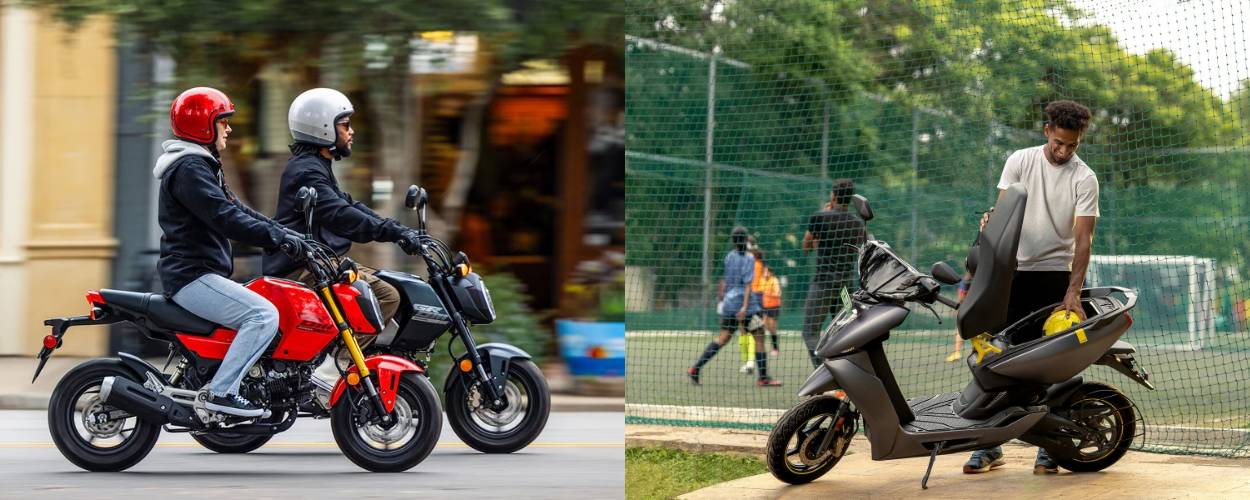
Two wheels. Smaller engine. Easy to ride. Affordable to own.
On paper, mini motos and scooters have a lot in common. In practice, they offer pretty different riding experiences. If you are trying to figure out which one fits your life, here is what actually sets them apart.
What They Share
Before getting into the differences, it is worth acknowledging the overlap.
Both mini motos and scooters are approachable for newer riders. Both are lightweight and easy to maneuver in urban environments. Both tend to be more affordable than larger motorcycles. And both are genuinely fun to ride.
If you are drawn to either one, you are already thinking about motorcycling smartly. The question is which experience you are actually after.
How You Ride Them
This is the biggest practical difference between the two.
Most scooters use an automatic transmission. You twist the throttle and go. There is no clutch, no gear shifting, and very little barrier to getting started. The step-through frame makes mounting easy, and a flat floorboard gives you a relaxed, natural riding position from day one. For riders who want the simplest possible on-ramp into riding, a scooter is hard to beat.
Mini motos typically use a manual transmission with a clutch and gears, just like a full-size motorcycle, though some automatic options are available. That means there is a learning curve, but it is also the kind of learning that pays off. The skills you build on a mini moto transfer directly to larger bikes, and the riding position is sportier and more engaged. You straddle the frame, your feet rest on pegs, and the bike responds with a quickness that feels playful rather than purely practical.
If you want simplicity right now, scooter. If you want to build real motorcycle skills from day one, mini-moto.
Where Each One Shines
Scooters are purpose-built for urban life. Short commutes, stop-and-go traffic, tight parking situations, and quick errands. Storage is often built in. The automatic transmission and step-through design make them effortless to operate in exactly the conditions most city riders deal with every day. If practical, low-maintenance transportation is the goal, a scooter delivers.
Mini motos handle city riding just as well, but they bring something extra. They have a strong community around them, a cult following across all skill levels, and a personality that is hard to describe until you ride one. Riders often keep them around not just for commuting but for the pure enjoyment of something light and responsive. They are also a natural stepping stone if you ever want to move to a larger bike, since the skills transfer directly.
Who Rides Each One
Scooters attract riders who want accessible, practical transportation with minimal complexity. Newer riders who are not yet ready for a manual transmission. Commuters who want to get from A to B efficiently. People who want two wheels without a steep learning curve.
Mini motos attract a wider range than most people expect. Newer riders love them for the low seat height, manageable power, and forgiving lightweight frame. Experienced riders love them for the precision they demand and the fun they deliver. A small, agile bike with a responsive throttle forces you to be precise in a way that larger bikes do not. A lot of seasoned riders keep one in the garage alongside bigger bikes just because it is that enjoyable to ride.
Which One Is Right for You
If you want the easiest, most accessible way to start riding and your primary goal is practical transportation around town, a scooter is a great fit.
If you want something that feels like a motorcycle, builds transferable skills, and comes with a community of riders who are genuinely enthusiastic about what they ride, a mini moto is worth a serious look.
Both are good answers. It just depends on what kind of rider you want to become.
Ready to find your fit? Explore mini motos, scooters, and every other type of motorcycle at our bike finder. And if you are just getting started, our beginner guide to motorcycle types is a great place to begin.