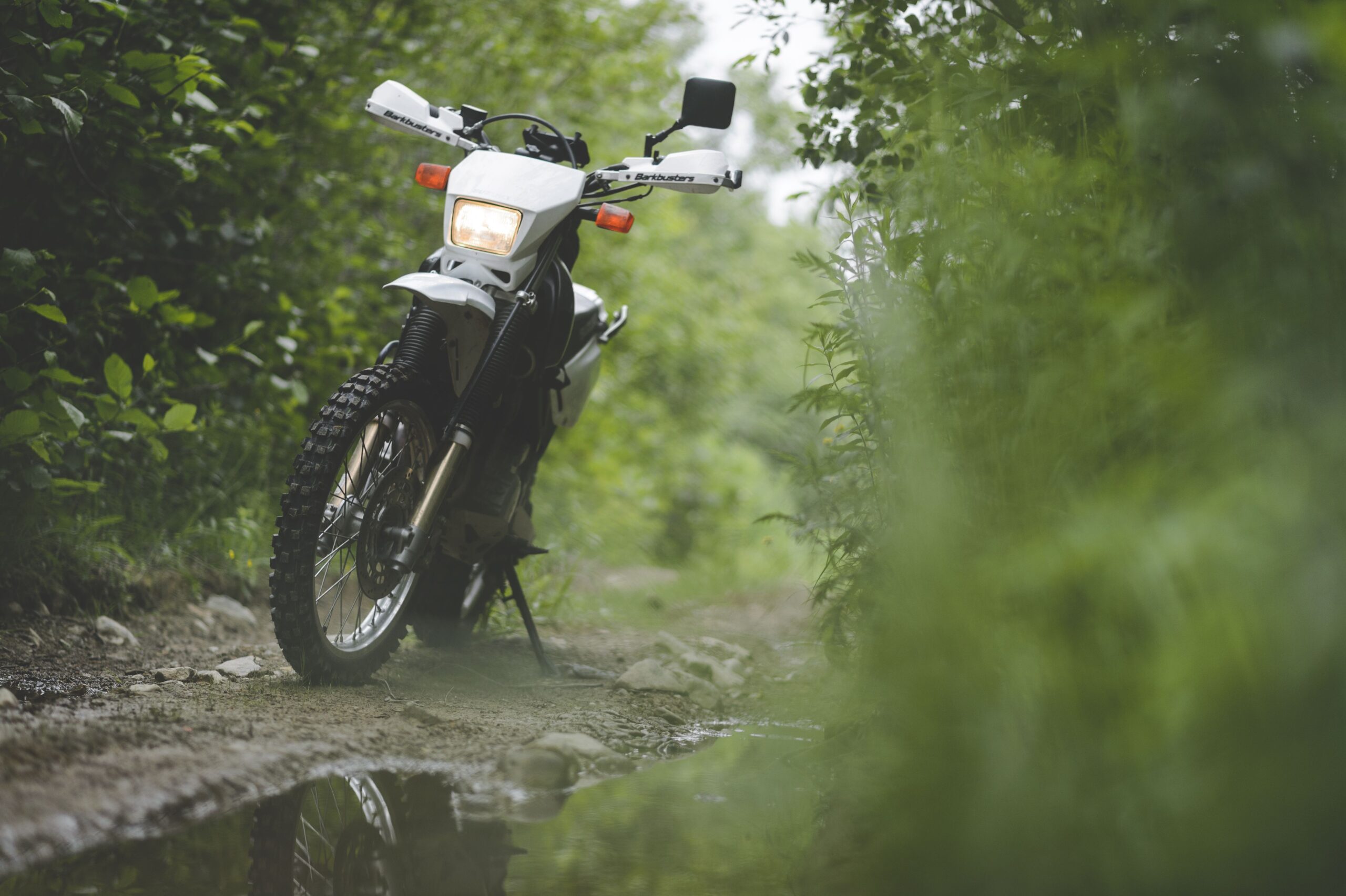
Saturday morning starts on pavement, the same as most rides. Somewhere along the way, often without much warning, the road narrows, the shoulder disappears, and pavement gives way to gravel. On most bikes, that shift is an event. On a dual sport, it’s part of the fun. Here’s the experience of riding one over a weekend.
The Pavement Doesn’t Last (and Here Is Why That’s Fine)
A dual sport handles a terrain transition because of what is actually built into the bike, not luck or nerve.
Suspension travel is longer than what you get on a standard street bike, often somewhere between six and nine inches at each end. That extra travel absorbs the bumps, ruts, and washboard sections that would otherwise rattle a rider on a lower travel setup. Ground clearance is higher too, which means rocks and ridges that would catch the bottom of a street bike simply pass underneath.
The tires do just as much work. Dual-purpose tires use a tread pattern built to grip both pavement and loose surfaces, a middle point between street tires and true off-road knobbies. They won’t outperform a dedicated tire on either surface, but that tradeoff is the entire point. One tire, two environments.
Add in the upright seating position, which keeps your weight centered over the bike instead of stretched forward, and you get a machine built specifically to make the pavement-to-dirt transition uneventful.
Reading the Terrain Before You Are On It
The more time you spend on a dual sport, the more you start reading the road ahead instead of reacting to it after the fact.
Loose gravel looks different from hardpack. Gravel tends to have a lighter, more textured surface, and it often collects at the edges of a road or down the center where car tires do not typically travel. Hardpack looks smoother and more compressed, closer in color and texture to a dirt path than scattered stone. Wet leaves show up as darker patches, especially in shaded areas that don’t get much sun, and they behave differently underneath you than wet pavement even at low speed. Sand tends to appear as lighter, looser patches that visibly shift compared to the ground around them.
Once you can identify what is ahead, you can adjust before you are on it instead of after. Standing on the pegs lowers your center of gravity and lets your legs absorb impact instead of your spine. Loosening your grip on the handlebars allows the front wheel to move naturally over uneven ground rather than fighting you for a straight line. On a downhill section, shifting your weight back keeps the front end light and keeps it from digging into looser surfaces.
None of this is complicated once you know what you are looking at. Like most other skills in motorcycling, it’s built through repetition.
Why the Slower Pace Is a Skill, Not a Limitation
Riders who are new to dual sport often expect the slower pace to feel like a downgrade from pavement speed. It’s not; it is a different skill set entirely, and one that rewards smoothness over speed.
Traction on loose surfaces behaves differently than it does on pavement. Aggressive throttle input on gravel or dirt can break the rear tire loose faster than most riders expect, and heavy front brake pressure can do the same to the front end. The fix is not caution for its own sake. It is smoother, more deliberate inputs across the board: rolling onto the throttle instead of snapping it open, applying brake pressure gradually instead of all at once, and making small corrections instead of large ones.
This is a genuinely different kind of riding than what most new riders practice on pavement, and it translates directly into better control everywhere else you ride. Slowing down on a dual sport is not the absence of skill, but where the skill actually gets built.
What a Weekend Like This Actually Teaches You
By the end of a weekend spent moving between pavement and dirt, most riders notice something beyond tired legs and a dusty bike. The terrain reading, the smoother inputs, the comfort with a changing surface…all of it carries over.
Riders who spend time on mixed terrain tend to handle unexpected pavement conditions, like sand at an intersection or gravel scattered across a shoulder, with more composure than riders who have only ridden on consistent surfaces. The skills built on a dual sport are not specific to dirt roads; they’re skills that make you a more capable rider everywhere you ride, on any bike.
The Bigger Point
A dual sport weekend is not really about the bike. It is about the kind of riding it teaches you to do: reading terrain before you are on it, adjusting early instead of reacting late, and staying smooth when the surface underneath you changes without warning. That is a skill set worth building, whether or not you end up putting many miles on gravel again anytime soon.
If you are curious whether a dual sport fits how you want to ride, our guide to dual sport motorcycles breaks down what makes them different and who tends to love them most.